Claire de Lune
by Jacob Baugher
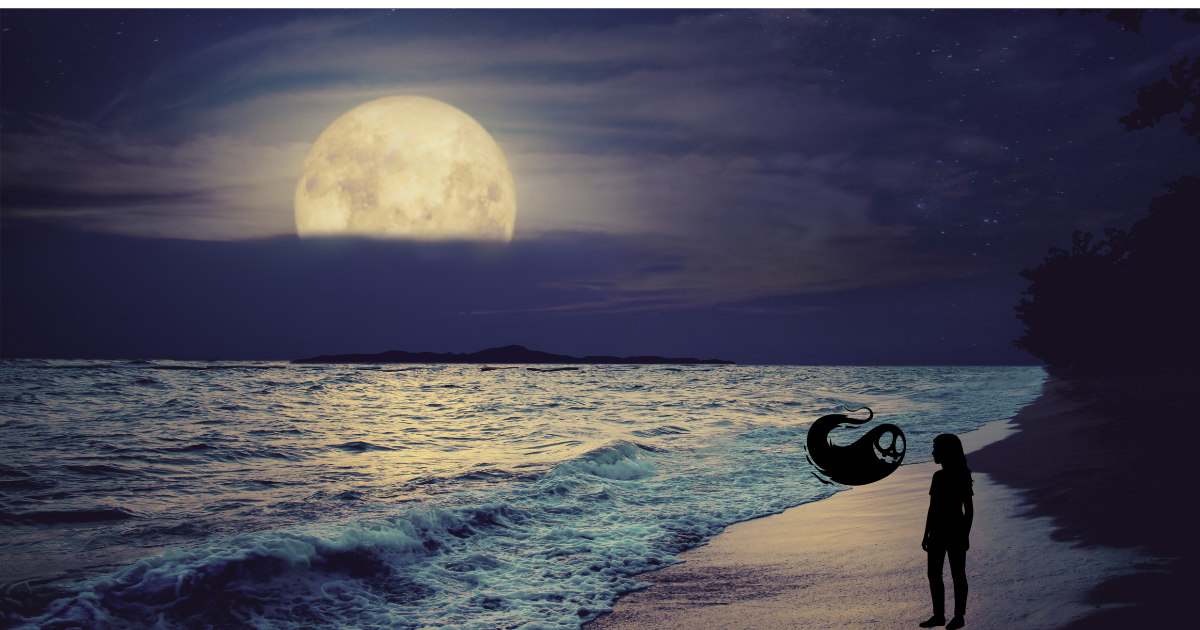
She comes back to the Carousel House in the blue evening, solitary on the Carolina seaside. Her black Samsonite makes looping tracks on the cold beach, dragging sand across the house’s threshold. She stays here sometimes when she needs refuge, pretends to be one with the uncaring sea. She brings white wine, a swimsuit, a paperback for the lonely bed. A pocket square full of memories for the loose-eyed ghost in the basement who shows her what could have been.
Her smartphone’s flashlight scatters the darkness in the mudroom. There’s a photo on the wall: two hammerheads circling, taken from below. Dark shadows against a glittering sky. The phone buzzes. You wrre pwrfect brfor kids. A message from her husband (for now), drunk and making it everyone’s problem.
The basement stairs thump hollowly as she descends, spiraling down into the dark cellar. It’s wide-open and dominated by a piecemeal carousel, apparently cannibalized from several others. One ocean-themed, one ponies, one cracked cartoon characters with flaking paint.
“I was wondering if you’d ever come back.” The loose-eyed ghost leans against a jumper car: three purple jellyfish pulling a carriage. One of his eyes lolls out of its socket, wobbles down his cheek, dangling by the optic nerve. He plucks it up and shoves it back.
“I’m here now.” She unzips her luggage, removes the pocket square her husband wore at their wedding. It’s tied like a tiny sack, memories vibrating within. “I’d like to see him again.”
The ghost fades from the car, reconstitutes next to her, and takes the fabric. He smells like cigarettes, motor oil, funnel cakes.
“What are these?”
“Pieces of me,” she says.
“Pieces of your husband.”
“Of us both.”
The cloudy incandescents lining the carousel flicker on, fill the basement with golden light and the scent of hot glass. She mounts her usual jumper, an ivory Clydesdale with an ostrich feather plume. Her phone buzzes. —dsmaged goods—she stops reading.
“Things not going well at home?” the ghost asks.
She ignores him, just as she’s ignored the onslaught of increasingly vitriolic texts.
The ghost unwraps the pocket square. Inside, three orbs glow softly blue. He snatches one up, produces thin paper from his breast pocket, and rolls a cigarette. He lights it with a green flame conjured on his thumb.
The carousel shudders and starts turning. The basement's dim corners and cobwebs, the ghost, the little square of moonlight at the top of the stairwell swirls and blurs into a slurry of golden light that consumes her.
She’s at the airport bar nursing a gin and tonic, not six hours ago. Text messages scroll across the phone. She finishes her drink, slips off the stool, heads to her flight.
He walks in a moment later, the man the carousel has been showing her since she was sixteen and heartbroken. He’s blond, well-built, and there’s a kindness around his blue eyes that makes her feel safe. A violin’s flight case rests under the bar. He orders one of those new non-alcoholic beers.
The image fades, and she’s back in the basement. Both of the loose-eyed ghost’s eyeballs are dangling down his face. He drags on the cigarette.
“Where will he be next?” she asks.
“You know it doesn’t work like that.” He makes a snorting sound. His eyes suck back up to their sockets.
It’s always been like this. They’d been as close as sharing a hotel room wall, missing each other’s comings and goings by a few seconds. Once, on the same flight, opposite corners of the cabin.
“Another possibility?”
“The one from college. When I switched majors.”
The ghost rolls another orb into a cigarette. The carousel whirls. A stage is set out before her, a production of Thoroughly Modern Millie. Not on Broadway, not yet, but at Laura Pels. She plays Miss Dorothy. After the show, the blond-haired man comes backstage with flowers, kisses her.
The basement rushes back, and she remembers that she’s not an actress, but a C.P.A. with a bit of an oxy problem.
“Why do I always see him?”
“Perhaps he is the key to your happiness,” the ghost suggests. “Another?”
She’s in New York again. Instead of stumbling home from the bar with her husband and accidentally conceiving their first, she goes out with her friends to a music venue. The blond-haired man is there, playing his violin. They leave together, and he introduces her to his casting director friend.
The ghost watches her. She grasps the Clydesdale for support, lightheaded, as she always is after bartering parts of herself away.
“For another memory, I can show you more possibilities.”
“No. I want to watch the waves awhile.”
Upstairs, she changes in the sparse bedroom, drags the Samsonite down the beach, and pops the cork on the wine. Her phone buzzes. A text message—something ugly and cruel from someone she no longer remembers. She blocks the number, thinks about her children who are staying with their grandmother, and lets the bottle and the waves lull her to sleep.
The loose-eyed ghost watches from afar, then returns to the basement, smoking his cigarette of stolen memory. He walks the floorboards to the jumper with the purple jellyfish, lifts the carriage’s seat. Hundreds of spent cigarette butts faintly glow. He plunges his hand into them, removes a black case. Inside, there’s a cherry-red violin. He raises it to his chin and plays. A piano accompaniment tinkles out from the carousel speakers. His song mingles with the moonlight.
The ride shudders, spins. Golden light imbues him, makes his hair longer, his cheeks fuller, eyes bright and blue and kind. Everything he thinks she wants. The glittering light forms another shape—her—made especially for him.
He reaches out, brushes her cheek, but she dissolves into a cloud of swirling sparks. A few more memories and the broken woman on the beach will fade, and this version will finally be his: perfect, forever.